UI / UX Design
VoyaTerra Project
Designed the brand identity, website, and content strategy of the VoyaTerra Travel Team.
Year :
2025
Industry :
Travel & Tourism
Client :
VoyaTerra
Project Duration :
6 Weeks
Problem :
Most travel platforms assume people plan trips logically. They ask you to start with a destination, dates, and a budget, then compare endless options until you land on something that feels “good enough.”
But that’s not how people actually decide to travel.
People start with feelings and intentions. They want rest. They want adventure without stress. They want meaningful experiences or to travel more responsibly, without spending hours researching every detail. Logic usually comes later, as a way to justify the decision.
This gap between how people decide and how platforms are structured creates real problems. Users feel overwhelmed by too many options that don’t meaningfully differ. Values like eco impact, cultural depth, or safety are often vague or hidden. Group trips become especially painful, with real planning happening across WhatsApp chats, spreadsheets, and shared notes, while the booking platform only captures the final click.
I saw this as a design problem, not a content or feature problem.
The real question became: what if travel discovery started with emotional intent and values, before asking users to commit to logistics?
Real-World Friction:
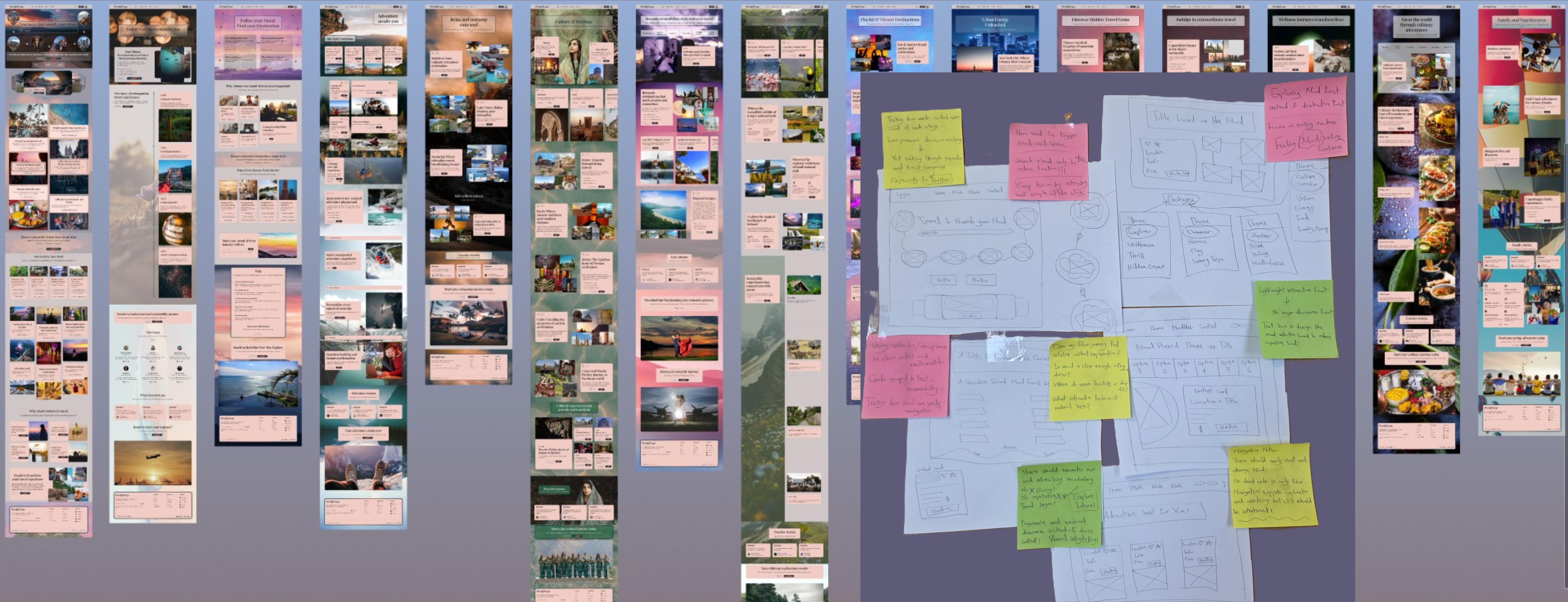
Instead of designing fixed personas, I focused on behavioural roles that show up naturally during travel planning. A single trip often includes very different needs at the same time.
Some people want spontaneity, speed, and good deals. Others care deeply about eco impact and local experiences. Some prioritise comfort and reassurance, especially when travelling with family. And in group trips, someone almost always becomes the organiser, managing coordination, compromises, and logistics.
These roles often clash, which adds friction to decision-making.
I also had to design around several constraints. Early in planning, many users struggle to clearly articulate what they want. Trust is fragile, especially around sustainability or safety claims. Too many choices increase anxiety instead of confidence. And planning itself can be mentally exhausting, which makes accessibility and cognitive load important from the start.
I knew that a mood-based approach could easily go wrong. If handled poorly, it could feel vague, gimmicky, or even more overwhelming than traditional filters. Avoiding that outcome shaped every design decision that followed.
Design Approach
I treated mood as a way to guide discovery, not as a personality label.
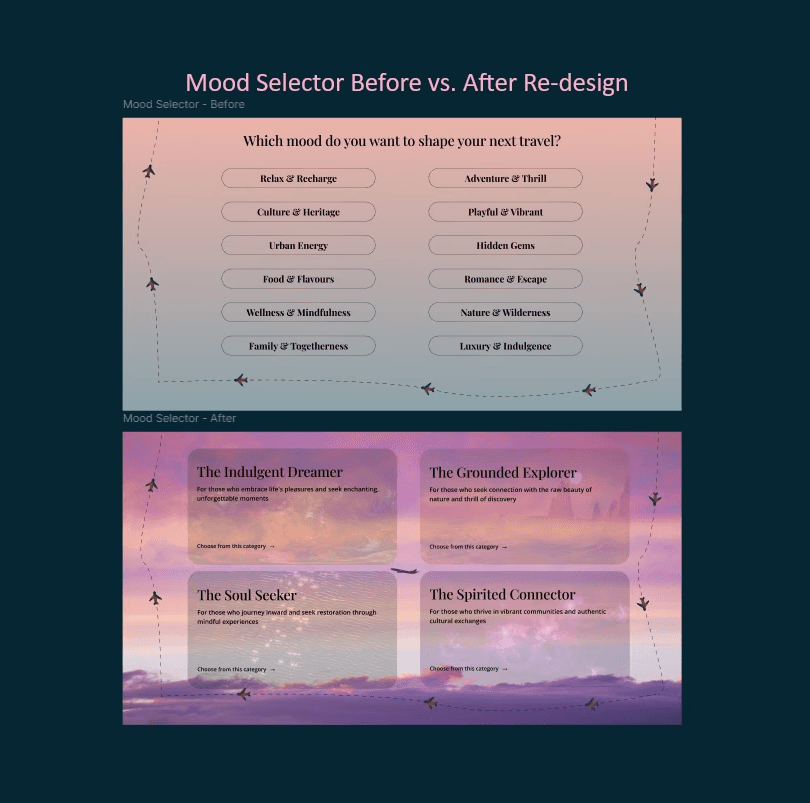
Early on, I explored twelve different travel moods to allow for nuance and self-expression. While this was emotionally rich, showing all twelve upfront created hesitation. People paused too long, compared options, and worried about choosing the “wrong” mood.
To fix this, I grouped the moods into four broader themes and revealed more detail gradually. This helped users make an initial emotional commitment without pressure, then refine their intent as they gained confidence. It reduced cognitive load while keeping the experience expressive.
Instead of relying on heavy filters, I structured discovery through what I think of as guided ambiguity. Users start with mood, then narrow options through interests, values, and effort or comfort levels. The experience feels less like comparison shopping and more like a conversation that gradually becomes clearer.
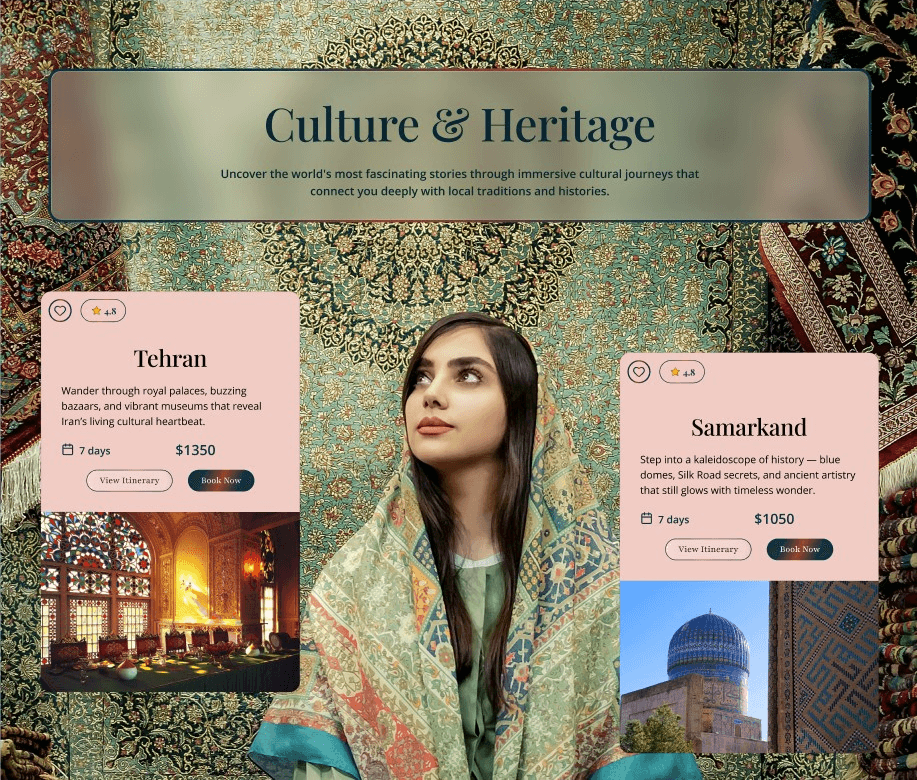
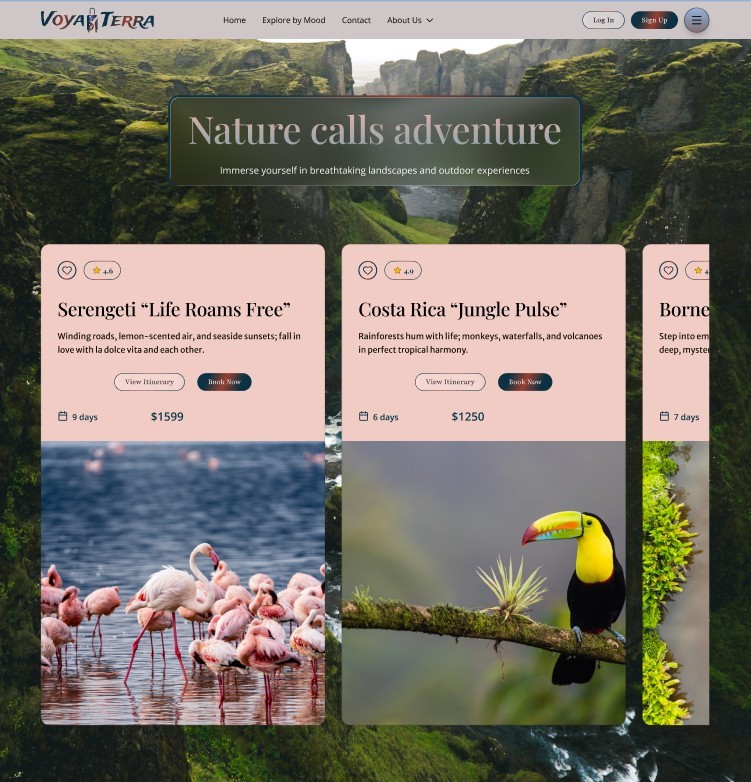
Language played a big role here. I treated microcopy as part of the UX, not as an afterthought. Button labels focus on adventurous progress rather than mere selection. Section titles help users reflect on intent before making choices. Introductory text reassures them that exploration is flexible and reversible. All of this helps reduce self-judgement and anxiety early on.
I also used layout, colour, and imagery to support storytelling. For example, I used visual rhythm and experiential imagery to create a sense of guided discovery rather than urgency. The interface is designed to slow people down just enough to think clearly.
Accessibility was part of this thinking too. I included high-contrast options and reduced-motion toggles, not just for compliance, but to support users who feel overwhelmed while planning.
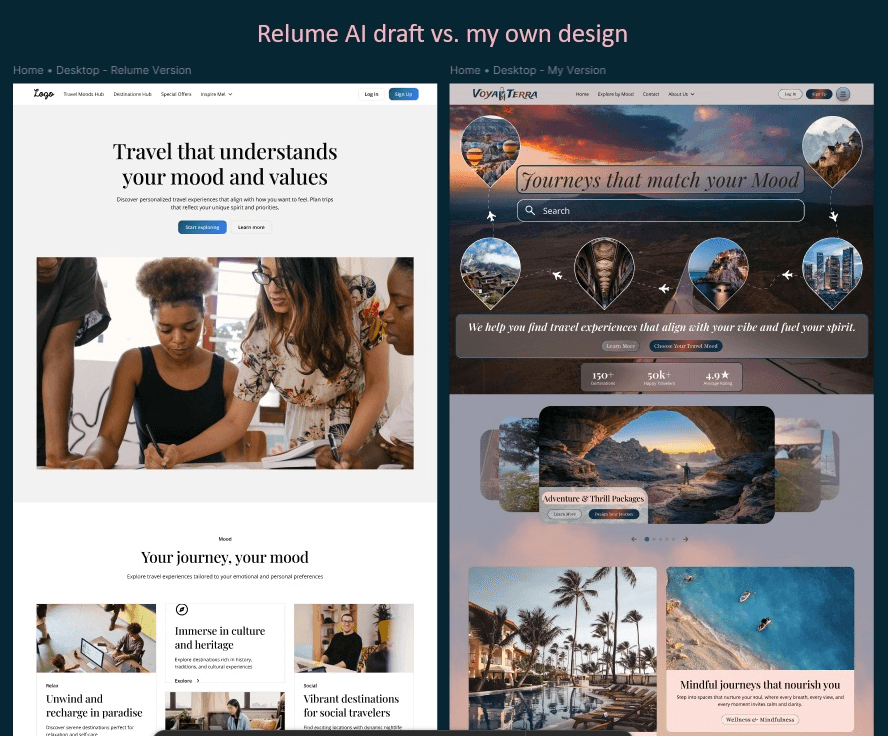
While Figma was my primary design environment, I briefly used Relume to accelerate early layout exploration. Beyond structure, however, the product required careful manual refinement, especially around emotional hierarchy, language, and flow. AI supported speed and exploration; design judgement defined the outcome.
Summary & Reflection:
VoyaTerra is about helping people make confident decisions. By starting with mood and values, the experience reduces decision fatigue and makes trade-offs clearer, especially for group travel. It also creates a clear point of differentiation without sacrificing usability or trust.
Overall, this project reflects how I approach UX: I design decision environments, not just interfaces. By using language, mood, and visual storytelling, I try to support how people actually make sense of complex choices, emotionally first, logically later, while still keeping the path to action clear.
More Projects

UI / UX Design
VoyaTerra Project
Designed the brand identity, website, and content strategy of the VoyaTerra Travel Team.
Year :
2025
Industry :
Travel & Tourism
Client :
VoyaTerra
Project Duration :
6 Weeks
Problem :
Most travel platforms assume people plan trips logically. They ask you to start with a destination, dates, and a budget, then compare endless options until you land on something that feels “good enough.”
But that’s not how people actually decide to travel.
People start with feelings and intentions. They want rest. They want adventure without stress. They want meaningful experiences or to travel more responsibly, without spending hours researching every detail. Logic usually comes later, as a way to justify the decision.
This gap between how people decide and how platforms are structured creates real problems. Users feel overwhelmed by too many options that don’t meaningfully differ. Values like eco impact, cultural depth, or safety are often vague or hidden. Group trips become especially painful, with real planning happening across WhatsApp chats, spreadsheets, and shared notes, while the booking platform only captures the final click.
I saw this as a design problem, not a content or feature problem.
The real question became: what if travel discovery started with emotional intent and values, before asking users to commit to logistics?
Real-World Friction:
Instead of designing fixed personas, I focused on behavioural roles that show up naturally during travel planning. A single trip often includes very different needs at the same time.
Some people want spontaneity, speed, and good deals. Others care deeply about eco impact and local experiences. Some prioritise comfort and reassurance, especially when travelling with family. And in group trips, someone almost always becomes the organiser, managing coordination, compromises, and logistics.
These roles often clash, which adds friction to decision-making.
I also had to design around several constraints. Early in planning, many users struggle to clearly articulate what they want. Trust is fragile, especially around sustainability or safety claims. Too many choices increase anxiety instead of confidence. And planning itself can be mentally exhausting, which makes accessibility and cognitive load important from the start.
I knew that a mood-based approach could easily go wrong. If handled poorly, it could feel vague, gimmicky, or even more overwhelming than traditional filters. Avoiding that outcome shaped every design decision that followed.
Design Approach
I treated mood as a way to guide discovery, not as a personality label.
Early on, I explored twelve different travel moods to allow for nuance and self-expression. While this was emotionally rich, showing all twelve upfront created hesitation. People paused too long, compared options, and worried about choosing the “wrong” mood.
To fix this, I grouped the moods into four broader themes and revealed more detail gradually. This helped users make an initial emotional commitment without pressure, then refine their intent as they gained confidence. It reduced cognitive load while keeping the experience expressive.
Instead of relying on heavy filters, I structured discovery through what I think of as guided ambiguity. Users start with mood, then narrow options through interests, values, and effort or comfort levels. The experience feels less like comparison shopping and more like a conversation that gradually becomes clearer.
Language played a big role here. I treated microcopy as part of the UX, not as an afterthought. Button labels focus on adventurous progress rather than mere selection. Section titles help users reflect on intent before making choices. Introductory text reassures them that exploration is flexible and reversible. All of this helps reduce self-judgement and anxiety early on.
I also used layout, colour, and imagery to support storytelling. For example, I used visual rhythm and experiential imagery to create a sense of guided discovery rather than urgency. The interface is designed to slow people down just enough to think clearly.
Accessibility was part of this thinking too. I included high-contrast options and reduced-motion toggles, not just for compliance, but to support users who feel overwhelmed while planning.
While Figma was my primary design environment, I briefly used Relume to accelerate early layout exploration. Beyond structure, however, the product required careful manual refinement, especially around emotional hierarchy, language, and flow. AI supported speed and exploration; design judgement defined the outcome.
Summary & Reflection:
VoyaTerra is about helping people make confident decisions. By starting with mood and values, the experience reduces decision fatigue and makes trade-offs clearer, especially for group travel. It also creates a clear point of differentiation without sacrificing usability or trust.
Overall, this project reflects how I approach UX: I design decision environments, not just interfaces. By using language, mood, and visual storytelling, I try to support how people actually make sense of complex choices, emotionally first, logically later, while still keeping the path to action clear.
More Projects
UI / UX Design
VoyaTerra Project
Designed the brand identity, website, and content strategy of the VoyaTerra Travel Team.
Year :
2025
Industry :
Travel & Tourism
Client :
VoyaTerra
Project Duration :
6 Weeks
Problem :
Most travel platforms assume people plan trips logically. They ask you to start with a destination, dates, and a budget, then compare endless options until you land on something that feels “good enough.”
But that’s not how people actually decide to travel.
People start with feelings and intentions. They want rest. They want adventure without stress. They want meaningful experiences or to travel more responsibly, without spending hours researching every detail. Logic usually comes later, as a way to justify the decision.
This gap between how people decide and how platforms are structured creates real problems. Users feel overwhelmed by too many options that don’t meaningfully differ. Values like eco impact, cultural depth, or safety are often vague or hidden. Group trips become especially painful, with real planning happening across WhatsApp chats, spreadsheets, and shared notes, while the booking platform only captures the final click.
I saw this as a design problem, not a content or feature problem.
The real question became: what if travel discovery started with emotional intent and values, before asking users to commit to logistics?
Real-World Friction:
Instead of designing fixed personas, I focused on behavioural roles that show up naturally during travel planning. A single trip often includes very different needs at the same time.
Some people want spontaneity, speed, and good deals. Others care deeply about eco impact and local experiences. Some prioritise comfort and reassurance, especially when travelling with family. And in group trips, someone almost always becomes the organiser, managing coordination, compromises, and logistics.
These roles often clash, which adds friction to decision-making.
I also had to design around several constraints. Early in planning, many users struggle to clearly articulate what they want. Trust is fragile, especially around sustainability or safety claims. Too many choices increase anxiety instead of confidence. And planning itself can be mentally exhausting, which makes accessibility and cognitive load important from the start.
I knew that a mood-based approach could easily go wrong. If handled poorly, it could feel vague, gimmicky, or even more overwhelming than traditional filters. Avoiding that outcome shaped every design decision that followed.
Design Approach
I treated mood as a way to guide discovery, not as a personality label.
Early on, I explored twelve different travel moods to allow for nuance and self-expression. While this was emotionally rich, showing all twelve upfront created hesitation. People paused too long, compared options, and worried about choosing the “wrong” mood.
To fix this, I grouped the moods into four broader themes and revealed more detail gradually. This helped users make an initial emotional commitment without pressure, then refine their intent as they gained confidence. It reduced cognitive load while keeping the experience expressive.
Instead of relying on heavy filters, I structured discovery through what I think of as guided ambiguity. Users start with mood, then narrow options through interests, values, and effort or comfort levels. The experience feels less like comparison shopping and more like a conversation that gradually becomes clearer.
Language played a big role here. I treated microcopy as part of the UX, not as an afterthought. Button labels focus on adventurous progress rather than mere selection. Section titles help users reflect on intent before making choices. Introductory text reassures them that exploration is flexible and reversible. All of this helps reduce self-judgement and anxiety early on.
I also used layout, colour, and imagery to support storytelling. For example, I used visual rhythm and experiential imagery to create a sense of guided discovery rather than urgency. The interface is designed to slow people down just enough to think clearly.
Accessibility was part of this thinking too. I included high-contrast options and reduced-motion toggles, not just for compliance, but to support users who feel overwhelmed while planning.
While Figma was my primary design environment, I briefly used Relume to accelerate early layout exploration. Beyond structure, however, the product required careful manual refinement, especially around emotional hierarchy, language, and flow. AI supported speed and exploration; design judgement defined the outcome.
Summary & Reflection:
VoyaTerra is about helping people make confident decisions. By starting with mood and values, the experience reduces decision fatigue and makes trade-offs clearer, especially for group travel. It also creates a clear point of differentiation without sacrificing usability or trust.
Overall, this project reflects how I approach UX: I design decision environments, not just interfaces. By using language, mood, and visual storytelling, I try to support how people actually make sense of complex choices, emotionally first, logically later, while still keeping the path to action clear.