UI / UX Design
Heala Project
Designed the brand identity and mobile application, and conducted foundational research to inform a clinician-connected nerve recovery experience.
Year :
2025
Industry :
Digital Health
Client :
Heala
Project Duration :
12 Weeks
Problem :
Recovering from nerve damage or movement loss rarely ends when a patient leaves the clinic. Most rehabilitation happens at home, where patients are expected to follow exercise programs on their own, track symptoms, and know when something is normal versus concerning. In practice, this is where recovery often breaks down.
Patients frequently feel anxious about doing exercises incorrectly or pushing too far. Pain, numbness, and slow progress can lead to frustration, missed sessions, or complete disengagement. Progress is hard to see, which makes motivation fragile. Communication with clinicians is often delayed or fragmented, leaving patients unsure whether what they are experiencing is expected or a warning sign.
Clinicians face a parallel problem. They manage large caseloads with limited visibility into what happens between appointments. They receive incomplete information, late signals about setbacks, and little time to personalise programmes beyond standard templates. Caregivers, when involved, are left without clear guidance or reassurance.
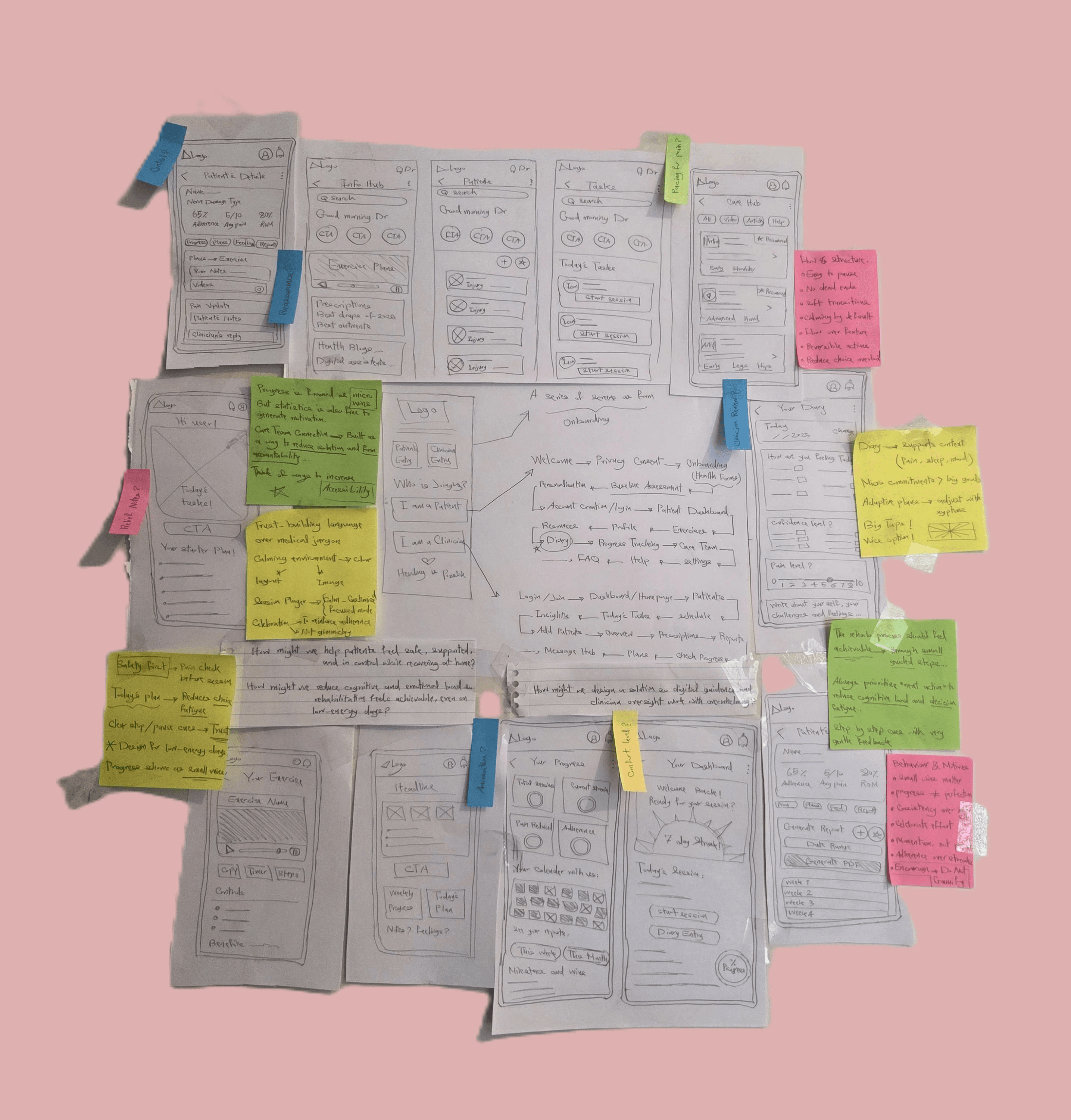
I saw this as a design problem rooted in lack of continuity, feedback, and trust. The challenge was to create a system that supports patients emotionally and practically during recovery, while giving clinicians meaningful oversight without increasing their workload.
Users, Constraints, and Clinical Reality:
I designed Heala around three core roles that interact throughout the recovery journey.
Patients are motivated to recover but often anxious. They want to follow instructions correctly, avoid making their condition worse, and see tangible signs of improvement. Clinicians need quick ways to triage issues, review progress, and adjust programmes safely across many patients. Caregivers need simple instructions and reassurance so they can support sessions without introducing risk.
Several constraints shaped the design. Rehabilitation data is sensitive, so consent, privacy, and transparency are non-negotiable. Safety must always take priority over engagement or speed. Patients’ physical and cognitive capacity can vary day to day, especially when pain or fatigue is involved. Clinicians have limited time and need signals, not noise.
There was also a clear design risk: a rehab app can easily become overwhelming, overly clinical, or motivational in a way that feels dismissive of pain and fear. Avoiding those pitfalls required careful choices around language, pacing, and interaction design.
Design Approach:
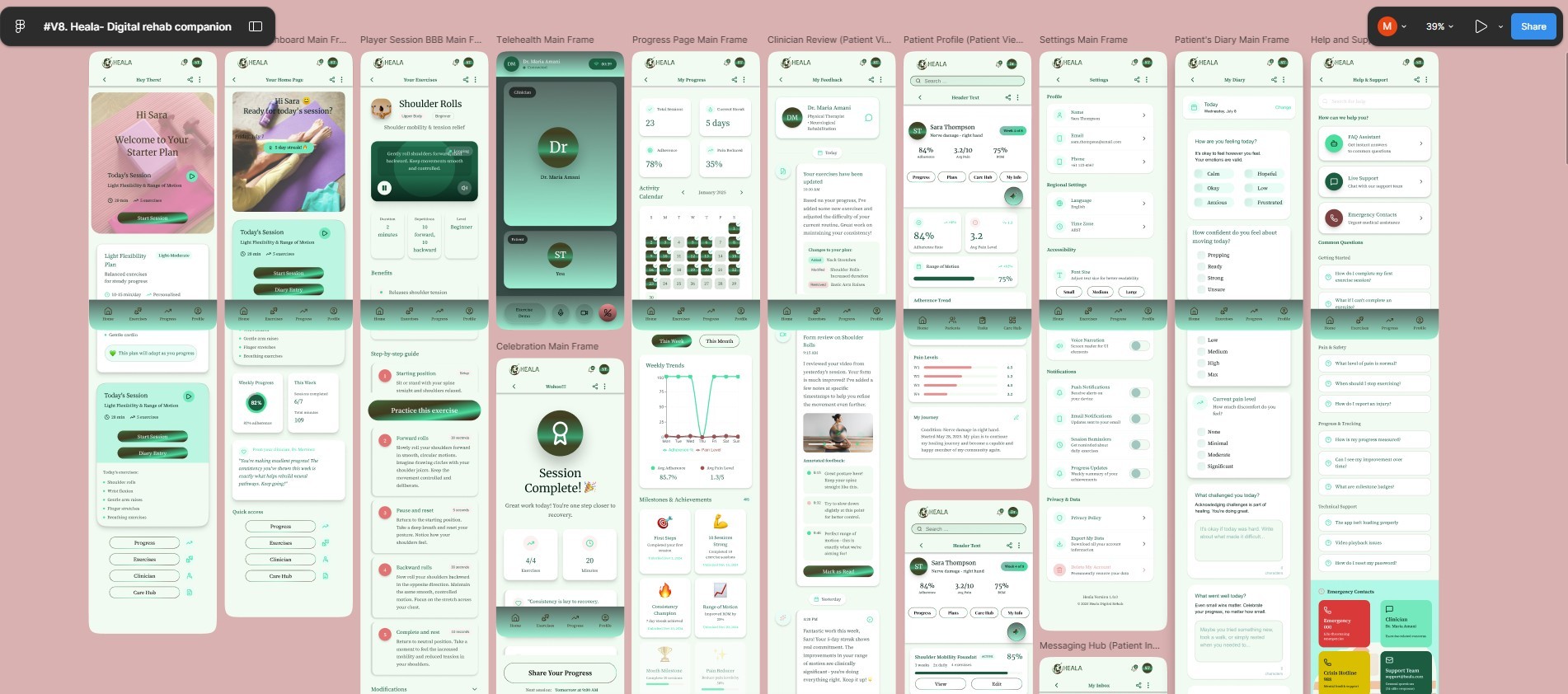
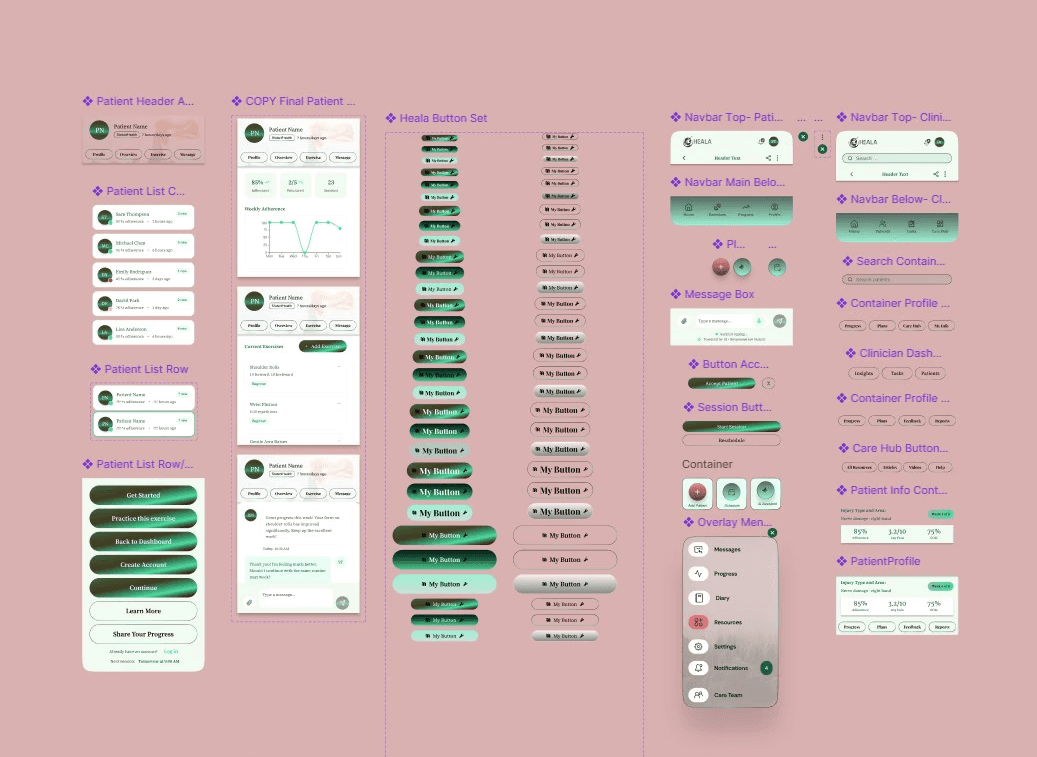
I approached Heala as a rehabilitation companion, not a tracking tool. The system is structured to guide patients step by step, while keeping clinicians in the loop. From a tooling perspective, I designed primarily in Figma.
Onboarding starts with a gentle, guided assessment that combines short questionnaires with simple movement tests supported by video and voice instructions. From this baseline, the system generates an initial rehabilitation programme, which clinicians can review and adjust. This balances automation with clinical authority and reassures patients that a professional is involved.
Daily use centres around a session player designed for clarity and safety. Each session begins with a quick check-in to capture pain or red flags. Exercises are delivered through short expert-led videos, clear step text, audio cues, and optional visual overlays to help patients understand correct movement. A prominent pause and stop option allows patients to log discomfort immediately, rather than pushing through uncertainty.
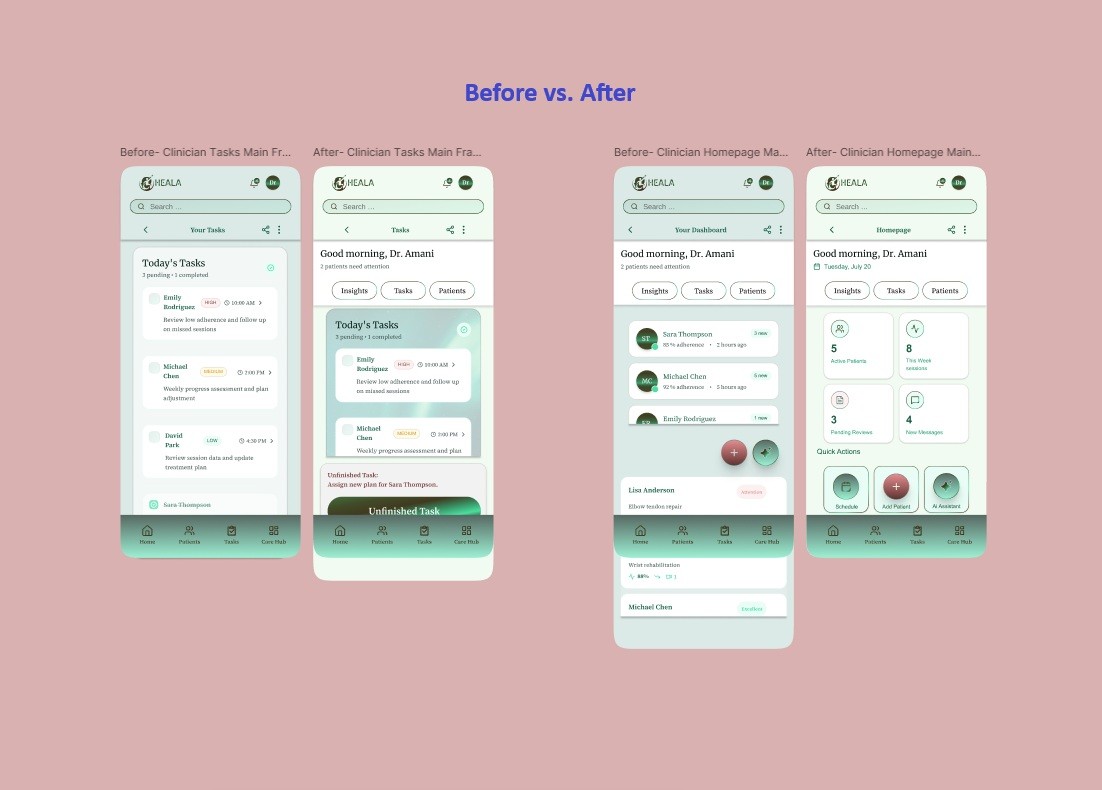
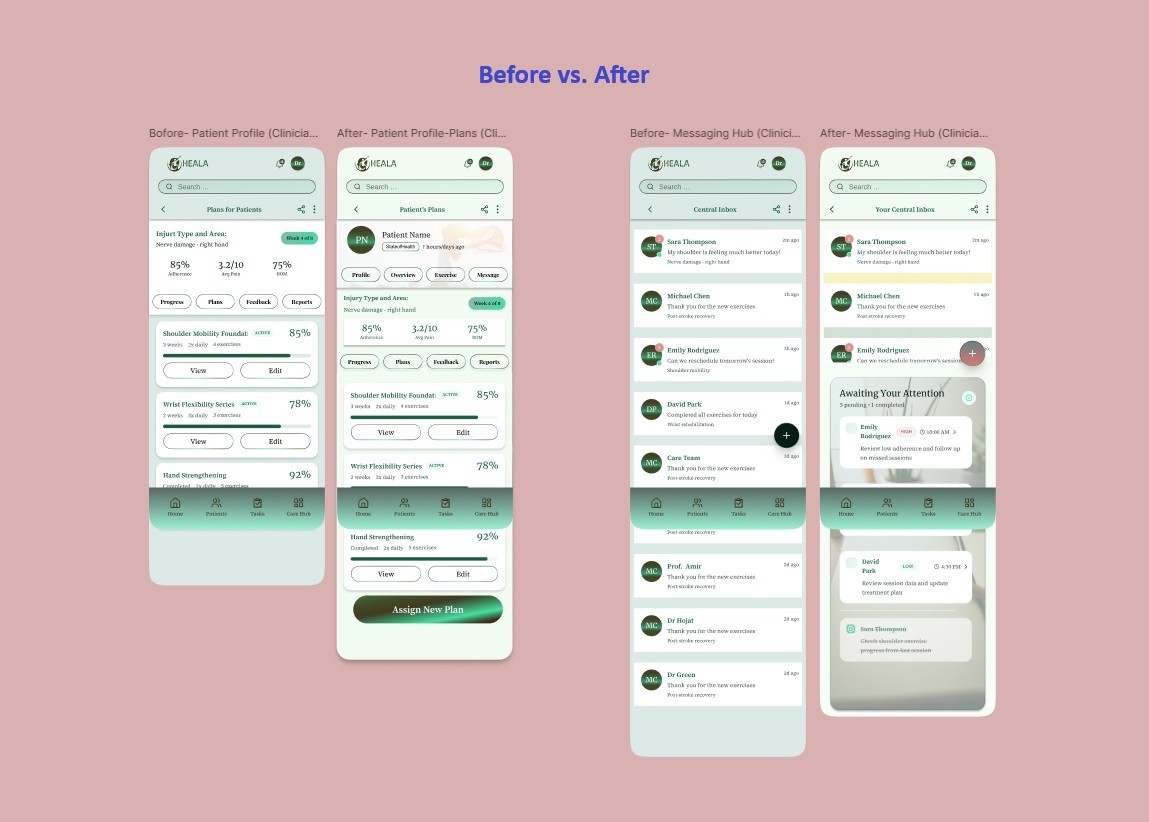
Clinician collaboration is largely asynchronous. Clinicians can review session logs, symptom diaries, and uploaded videos, then provide annotated feedback directly on patient recordings. This allows targeted coaching without requiring frequent live appointments. When needed, short teleconsultations are integrated into the same environment, with tools for co-viewing exercises and giving real-time guidance.
In Heala, colour is not primarily aesthetic, it’s regulatory. So, I used colour to manage anxiety, communicate safety, and support long-term engagement in a medical context where users are often in pain or uncertain about their progress.
The core palette is built around soft greens and teals, which are widely associated with calm, healing, and clinical trust. Unlike blues that can feel cold or overly institutional, or warm colours that can introduce urgency, these tones sit in a middle ground: reassuring without being passive. This was important because rehabilitation is not about crisis response, but about sustained, careful effort over time.
Language plays a critical role throughout the product. Microcopy is designed to reduce anxiety and self-blame. Instructions explain not just what to do, but why. Safety messages are clear and supportive rather than alarming. Progress messages focus on effort and consistency, not perfection.
Accessibility and inclusion are built in from the start. The app supports large tap targets, adjustable text, high-contrast themes, captions, and voice guidance. Exercises can be followed eyes-free, which is important for users with limited mobility or visual strain. Motion-reduced modes avoid unnecessary animation, especially during sessions.
Summary & Reflection:
Heala brings structure, reassurance, and visibility to a part of healthcare that is often isolating and opaque. For patients, it reduces uncertainty by showing what to do, how they are progressing, and when to ask for help. For clinicians, it creates a clearer picture of recovery between visits without adding unnecessary administrative burden. For caregivers, it offers guidance and confidence.
There are still open challenges. Rehabilitation varies widely across injury types and individuals, so adaptive programmes must be carefully validated. Sensor-based feedback requires transparency about accuracy and limitations to maintain trust. Long-term engagement beyond the initial recovery phase remains a critical area for exploration, particularly around maintenance and relapse prevention.
If developed further, I would focus on validating safety thresholds with clinicians, testing how patients interpret progress signals over time, and studying how asynchronous feedback affects adherence and confidence. I would also explore integration with existing clinical systems to support continuity of care.
Overall, Heala reflects how I approach healthcare design: by treating recovery as a human process, not just a clinical one. I design systems that prioritise safety, clarity, and emotional reassurance, while enabling clinicians to deliver care that is both scalable and personal.
More Projects


UI / UX Design
Heala Project
Designed the brand identity and mobile application, and conducted foundational research to inform a clinician-connected nerve recovery experience.
Year :
2025
Industry :
Digital Health
Client :
Heala
Project Duration :
12 Weeks
Problem :
Recovering from nerve damage or movement loss rarely ends when a patient leaves the clinic. Most rehabilitation happens at home, where patients are expected to follow exercise programs on their own, track symptoms, and know when something is normal versus concerning. In practice, this is where recovery often breaks down.
Patients frequently feel anxious about doing exercises incorrectly or pushing too far. Pain, numbness, and slow progress can lead to frustration, missed sessions, or complete disengagement. Progress is hard to see, which makes motivation fragile. Communication with clinicians is often delayed or fragmented, leaving patients unsure whether what they are experiencing is expected or a warning sign.
Clinicians face a parallel problem. They manage large caseloads with limited visibility into what happens between appointments. They receive incomplete information, late signals about setbacks, and little time to personalise programmes beyond standard templates. Caregivers, when involved, are left without clear guidance or reassurance.
I saw this as a design problem rooted in lack of continuity, feedback, and trust. The challenge was to create a system that supports patients emotionally and practically during recovery, while giving clinicians meaningful oversight without increasing their workload.
Users, Constraints, and Clinical Reality:
I designed Heala around three core roles that interact throughout the recovery journey.
Patients are motivated to recover but often anxious. They want to follow instructions correctly, avoid making their condition worse, and see tangible signs of improvement. Clinicians need quick ways to triage issues, review progress, and adjust programmes safely across many patients. Caregivers need simple instructions and reassurance so they can support sessions without introducing risk.
Several constraints shaped the design. Rehabilitation data is sensitive, so consent, privacy, and transparency are non-negotiable. Safety must always take priority over engagement or speed. Patients’ physical and cognitive capacity can vary day to day, especially when pain or fatigue is involved. Clinicians have limited time and need signals, not noise.
There was also a clear design risk: a rehab app can easily become overwhelming, overly clinical, or motivational in a way that feels dismissive of pain and fear. Avoiding those pitfalls required careful choices around language, pacing, and interaction design.
Design Approach:
I approached Heala as a rehabilitation companion, not a tracking tool. The system is structured to guide patients step by step, while keeping clinicians in the loop. From a tooling perspective, I designed primarily in Figma.
Onboarding starts with a gentle, guided assessment that combines short questionnaires with simple movement tests supported by video and voice instructions. From this baseline, the system generates an initial rehabilitation programme, which clinicians can review and adjust. This balances automation with clinical authority and reassures patients that a professional is involved.
Daily use centres around a session player designed for clarity and safety. Each session begins with a quick check-in to capture pain or red flags. Exercises are delivered through short expert-led videos, clear step text, audio cues, and optional visual overlays to help patients understand correct movement. A prominent pause and stop option allows patients to log discomfort immediately, rather than pushing through uncertainty.
Clinician collaboration is largely asynchronous. Clinicians can review session logs, symptom diaries, and uploaded videos, then provide annotated feedback directly on patient recordings. This allows targeted coaching without requiring frequent live appointments. When needed, short teleconsultations are integrated into the same environment, with tools for co-viewing exercises and giving real-time guidance.
In Heala, colour is not primarily aesthetic, it’s regulatory. So, I used colour to manage anxiety, communicate safety, and support long-term engagement in a medical context where users are often in pain or uncertain about their progress.
The core palette is built around soft greens and teals, which are widely associated with calm, healing, and clinical trust. Unlike blues that can feel cold or overly institutional, or warm colours that can introduce urgency, these tones sit in a middle ground: reassuring without being passive. This was important because rehabilitation is not about crisis response, but about sustained, careful effort over time.
Language plays a critical role throughout the product. Microcopy is designed to reduce anxiety and self-blame. Instructions explain not just what to do, but why. Safety messages are clear and supportive rather than alarming. Progress messages focus on effort and consistency, not perfection.
Accessibility and inclusion are built in from the start. The app supports large tap targets, adjustable text, high-contrast themes, captions, and voice guidance. Exercises can be followed eyes-free, which is important for users with limited mobility or visual strain. Motion-reduced modes avoid unnecessary animation, especially during sessions.
Summary & Reflection:
Heala brings structure, reassurance, and visibility to a part of healthcare that is often isolating and opaque. For patients, it reduces uncertainty by showing what to do, how they are progressing, and when to ask for help. For clinicians, it creates a clearer picture of recovery between visits without adding unnecessary administrative burden. For caregivers, it offers guidance and confidence.
There are still open challenges. Rehabilitation varies widely across injury types and individuals, so adaptive programmes must be carefully validated. Sensor-based feedback requires transparency about accuracy and limitations to maintain trust. Long-term engagement beyond the initial recovery phase remains a critical area for exploration, particularly around maintenance and relapse prevention.
If developed further, I would focus on validating safety thresholds with clinicians, testing how patients interpret progress signals over time, and studying how asynchronous feedback affects adherence and confidence. I would also explore integration with existing clinical systems to support continuity of care.
Overall, Heala reflects how I approach healthcare design: by treating recovery as a human process, not just a clinical one. I design systems that prioritise safety, clarity, and emotional reassurance, while enabling clinicians to deliver care that is both scalable and personal.
More Projects
UI / UX Design
Heala Project
Designed the brand identity and mobile application, and conducted foundational research to inform a clinician-connected nerve recovery experience.
Year :
2025
Industry :
Digital Health
Client :
Heala
Project Duration :
12 Weeks
Problem :
Recovering from nerve damage or movement loss rarely ends when a patient leaves the clinic. Most rehabilitation happens at home, where patients are expected to follow exercise programs on their own, track symptoms, and know when something is normal versus concerning. In practice, this is where recovery often breaks down.
Patients frequently feel anxious about doing exercises incorrectly or pushing too far. Pain, numbness, and slow progress can lead to frustration, missed sessions, or complete disengagement. Progress is hard to see, which makes motivation fragile. Communication with clinicians is often delayed or fragmented, leaving patients unsure whether what they are experiencing is expected or a warning sign.
Clinicians face a parallel problem. They manage large caseloads with limited visibility into what happens between appointments. They receive incomplete information, late signals about setbacks, and little time to personalise programmes beyond standard templates. Caregivers, when involved, are left without clear guidance or reassurance.
I saw this as a design problem rooted in lack of continuity, feedback, and trust. The challenge was to create a system that supports patients emotionally and practically during recovery, while giving clinicians meaningful oversight without increasing their workload.
Users, Constraints, and Clinical Reality:
I designed Heala around three core roles that interact throughout the recovery journey.
Patients are motivated to recover but often anxious. They want to follow instructions correctly, avoid making their condition worse, and see tangible signs of improvement. Clinicians need quick ways to triage issues, review progress, and adjust programmes safely across many patients. Caregivers need simple instructions and reassurance so they can support sessions without introducing risk.
Several constraints shaped the design. Rehabilitation data is sensitive, so consent, privacy, and transparency are non-negotiable. Safety must always take priority over engagement or speed. Patients’ physical and cognitive capacity can vary day to day, especially when pain or fatigue is involved. Clinicians have limited time and need signals, not noise.
There was also a clear design risk: a rehab app can easily become overwhelming, overly clinical, or motivational in a way that feels dismissive of pain and fear. Avoiding those pitfalls required careful choices around language, pacing, and interaction design.
Design Approach:
I approached Heala as a rehabilitation companion, not a tracking tool. The system is structured to guide patients step by step, while keeping clinicians in the loop. From a tooling perspective, I designed primarily in Figma.
Onboarding starts with a gentle, guided assessment that combines short questionnaires with simple movement tests supported by video and voice instructions. From this baseline, the system generates an initial rehabilitation programme, which clinicians can review and adjust. This balances automation with clinical authority and reassures patients that a professional is involved.
Daily use centres around a session player designed for clarity and safety. Each session begins with a quick check-in to capture pain or red flags. Exercises are delivered through short expert-led videos, clear step text, audio cues, and optional visual overlays to help patients understand correct movement. A prominent pause and stop option allows patients to log discomfort immediately, rather than pushing through uncertainty.
Clinician collaboration is largely asynchronous. Clinicians can review session logs, symptom diaries, and uploaded videos, then provide annotated feedback directly on patient recordings. This allows targeted coaching without requiring frequent live appointments. When needed, short teleconsultations are integrated into the same environment, with tools for co-viewing exercises and giving real-time guidance.
In Heala, colour is not primarily aesthetic, it’s regulatory. So, I used colour to manage anxiety, communicate safety, and support long-term engagement in a medical context where users are often in pain or uncertain about their progress.
The core palette is built around soft greens and teals, which are widely associated with calm, healing, and clinical trust. Unlike blues that can feel cold or overly institutional, or warm colours that can introduce urgency, these tones sit in a middle ground: reassuring without being passive. This was important because rehabilitation is not about crisis response, but about sustained, careful effort over time.
Language plays a critical role throughout the product. Microcopy is designed to reduce anxiety and self-blame. Instructions explain not just what to do, but why. Safety messages are clear and supportive rather than alarming. Progress messages focus on effort and consistency, not perfection.
Accessibility and inclusion are built in from the start. The app supports large tap targets, adjustable text, high-contrast themes, captions, and voice guidance. Exercises can be followed eyes-free, which is important for users with limited mobility or visual strain. Motion-reduced modes avoid unnecessary animation, especially during sessions.
Summary & Reflection:
Heala brings structure, reassurance, and visibility to a part of healthcare that is often isolating and opaque. For patients, it reduces uncertainty by showing what to do, how they are progressing, and when to ask for help. For clinicians, it creates a clearer picture of recovery between visits without adding unnecessary administrative burden. For caregivers, it offers guidance and confidence.
There are still open challenges. Rehabilitation varies widely across injury types and individuals, so adaptive programmes must be carefully validated. Sensor-based feedback requires transparency about accuracy and limitations to maintain trust. Long-term engagement beyond the initial recovery phase remains a critical area for exploration, particularly around maintenance and relapse prevention.
If developed further, I would focus on validating safety thresholds with clinicians, testing how patients interpret progress signals over time, and studying how asynchronous feedback affects adherence and confidence. I would also explore integration with existing clinical systems to support continuity of care.
Overall, Heala reflects how I approach healthcare design: by treating recovery as a human process, not just a clinical one. I design systems that prioritise safety, clarity, and emotional reassurance, while enabling clinicians to deliver care that is both scalable and personal.